NYSgpt was built using Next.js

NYSgpt: Five Tools That Treat New York's Public Data Like It Actually Matters
What does daycare actually cost in your county? Which auto insurance carrier is genuinely cheaper for someone with your driving record? Is your roof worth putting solar on? What does the bill your state senator just voted on actually say?
This information exists. But it's scattered across dozens of websites, buried in PDFs, locked behind search interfaces designed in 2003, or chopped up and resold by companies that mostly want to sell your email address to the highest bidder.
NYSgpt is five products built on a stubborn idea: that public data should be usable by the public. Not summarized by an AI guessing from training data. Not estimated by a lead-generation site pretending to know what your insurance will cost. Actually grounded in the real filings, the real registries, the real measurements — and made accessible through the kind of conversation you'd have with a knowledgeable friend.
So, here's what we built and why.
ChildcareGPT — Because finding childcare shouldn't be a part-time job
Anyone who has tried to find childcare in New York knows the drill. You start with a vague Google search. You end up on an app ready to take your money without providing you childcare. You call ten places. Three call back. Two have waitlists into next year. All the while childcare facilities, location and capacity data, is publicly available, but you'd never know that.
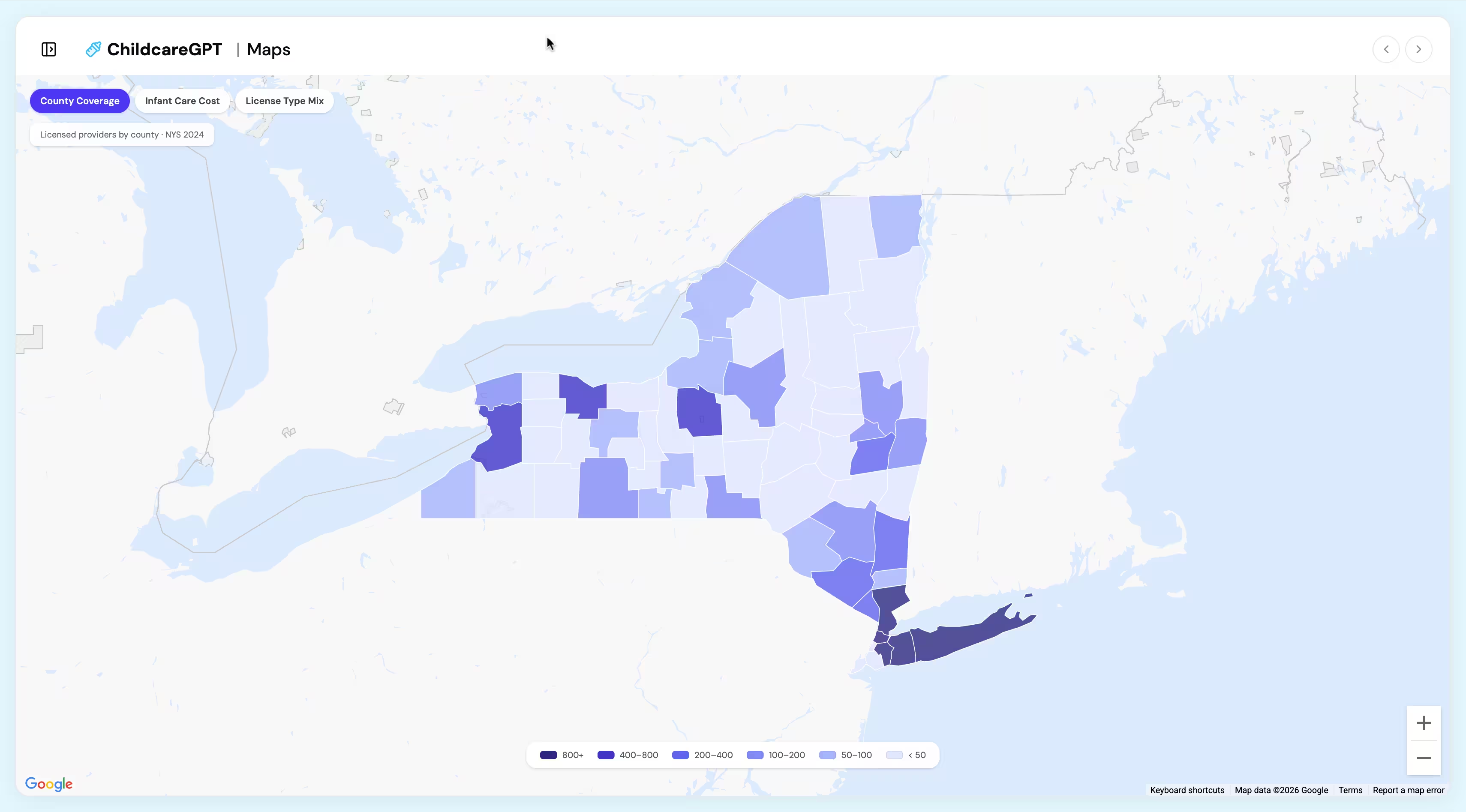
ChildcareGPT pulls regulated NYS childcare registries into one place. Every county, every city, every ZIP code, every individual facility — Group Family Day Care, Family Day Care, School Age Child Care, all of it. You can ask questions in plain English and get real answers, or you can inquire about availability with multiple agencies at the click of abutton. Looking for more? Browse maps that show you what's actually happening in your area. where the providers are, what they cost, how they rate on quality, whether there are subsidies you qualify for, how many kids per provider in your community.
The maps are the part we're proudest of. Provider distribution, subsidy eligibility, compliance and licensing, cost, quality ratings, provider-to-population ratios, median income — over the actual geography of New York. You can see, at a glance, what kind of childcare market you're living in. That's never existed before in a form a regular parent could just open and use and it's the kind of knowledge that makes life easier and policy better.
InsuranceGPT — A real comparison tool in an industry built on fake ones
The auto insurance "comparison" sites you've seen advertised are not comparison sites. They're lead farms. You enter your information, they show you a fake estimate, and then they sell your contact info to whichever insurance agent paid the most for it that day. The number on the screen has almost nothing to do with what you'll actually pay.
We thought that was insulting and built something different.
Every auto insurance carrier that operates in New York has to file their actual rates with the state Department of Financial Services. Those filings are public. They show — in painstaking detail — exactly how each carrier prices a policy based on your age, location, vehicle, driving record, and dozens of other factors. InsuranceGPT reads those filings and uses them to generate real comparisons across major carriers.
Think of it like a mortgage calculator that uses actual published rates instead of guesses. You answer questions about yourself the same way you would on any insurance site, but at the end you get something potentially, genuinely useful: a comparisons drawn from the carriers' actual filings.
There's also an Insurance Symbol Exchange that breaks down how much each specific vehicle costs to insure — again, pulled from the same DFS filings. If you're car shopping, that's the kind of information you want before you buy, not after. We think this makes life just a little bit easier and policy a bit better.
SolarGPT — Real answers about solar, for the moment you're actually deciding
Solar is one of those decisions where the marketing has badly outpaced the honest information. Every installer's website will tell you that you'll save thousands. Whether you will save thousands depends on your specific roof, your specific utility, your specific consumption patterns, and a dozen other things nobody will walk you through.
SolarGPT is built around two questions people actually ask. The first is the entry-level one: should I install solar at all? For that, we use a Google API to look at your specific roof and datasets from the National Renewable Energy Laboratory to model what the economics actually look like in your area. The answer might be yes. It might be no. But it'll be based on your roof, not a sales pitch.
The second question comes later: now that I have solar, how do I get the most out of it? That's where things get interesting — real-time market data, the possibility of joining virtual power plants or distributed energy aggregations, all the ways that a household solar setup can actually participate in the energy market.
The data underneath is sourced from Google Maps, NREL modeling, Department of Energy EIA reports on generation and consumption, and actual grid data. When you ask SolarGPT a question, it figures out whether you're asking about your roof, your neighborhood's grid, or the broader generation mix, and pulls from the right source.
ResearchGPT — Letting nuclear physicists talk to their literature
This one is more specialized, but it's the project that proves the whole approach works at the deep end of the pool.
The National Nuclear Data Center at Brookhaven National Laboratory maintains the Nuclear Science References database — the bibliographic record of nuclear physics measurement going back decades. About 46,000 papers from 2010 to 2026 alone. Until now, the way you searched it was the way you'd search a library card catalog from 1995: keywords, exact matches, fingers crossed.
ResearchGPT lets you have a conversation with the entire database. Ask a question the way you'd ask a colleague, and the system pulls from Semantic Scholar, the NNDC, the IAEA's nuclear data services, and Elsevier's research databases — and crucially, it connects the NSR layer (what experiments measured) to the ENDF library (how those measurements get turned into data physicists can actually use). That integration has never existed in a single tool before.
There's also a Live Feed where activity from one researcher quietly improves the experience for the next one and the community's collective curiosity becomes a feature.
PolicyGPT — Reading the laws being made in your name
The New York State Legislature passes hundreds of bills a session. Most New Yorkers will never read a single one. Not because they don't care — because reading legislation is genuinely hard, and finding the bill you want to read is harder.
PolicyGPT is a research tool for navigating, searching, and understanding New York State legislation and policy. You can ask it what a bill does. You can ask what's been introduced on a topic you care about. You can dig into the text without having to be a lawyer or a lobbyist to make sense of it.
It's the same idea as everything else here: information that's technically public but practically inaccessible, made into something you can actually use. It also has features backed into summarize a bill, generate a letter, and share it with the right officials in just 3 clicks. YOu don't need to know who chair's a committee or sponsored the bill; PolicyGPT answers those questions and directs your support/oppositioin to the right place.
What these have in common
Five products, five different domains, but the same belief running through all of them: the gap between publicly available data and actually usable data is enormous, and AI, used with purpose, gives us a real chance to change that, a chance reorganize the flow of information.
Every one of these is built on a real database of real records — childcare facility registries, insurance rate filings, federal energy data, peer-reviewed nuclear physics literature, state legislation.
We started with these five because they're the domains where the gap was widest and the stakes were highest — where families are making real decisions, where billions of dollars in rates are filed every year, where energy bills are paid, where research moves forward, where laws get made. There's nothing special about these domains. Anywhere there's authoritative public data trapped behind a clunky interface, the same approach works.
That's what NYSgpt is. Not a chatbot. Not a directory. It's a serious attempt to redirect the flow of information that shapes people's lives for the better.